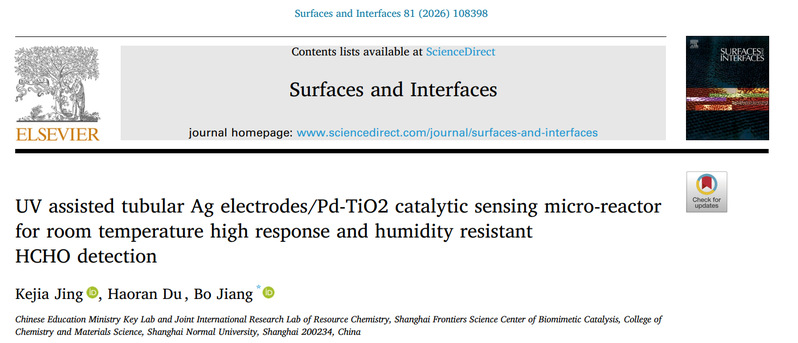
Recently, Jing Kejia, an undergraduate student from the top-tier Applied Chemistry Class of 2022 in the School of Chemistry and Chemical Engineering, published a significant research paper on formaldehyde detection as the first author in the international authoritative journal Surfaces and Interfaces. The paper, titled "UV-assisted tubular Ag electrodes/Pd-TiO2 catalytic sensing micro-reactor for room temperature high response and humidity-resistant HCHO detection," highlights the importance of efficient and sensitive real-time detection of formaldehyde (HCHO), a toxic and carcinogenic substance widely present in industrial products and indoor environments, for safeguarding human health and environmental safety.
This research project was supported by funding and technical assistance from multiple high-end platforms and initiatives, including the National Natural Science Foundation of China, the Shanghai Municipal Natural Science Foundation, the Key Laboratory of Resource Chemistry of the Ministry of Education, the International Joint Laboratory of Resource Chemistry, the Frontier Science Research Base of Biomimetic Catalysis in Shanghai, and the Key Laboratory of Rare Earth Functional Materials in Shanghai. In recent years, the School of Chemistry and Materials Science has established a training system combining "research mentors, research projects, and experimental platforms," actively encouraging undergraduates to participate in national and provincial-level research projects.
The paper can be accessed by clicking https://www.sciencedirect.com/journal/surfaces-and-interface.